Investor Membership
Investor Membership
Before designing the product, I had to rethink the study
Before designing the product, I had to rethink the study
Before designing the product, I had to rethink the study
I joined the project to design concepts, but first I needed to fix the research plan. One interview could not answer every question the team had
I joined the project to design concepts, but first I needed to fix the research plan. One interview could not answer every question the team had
I joined the project to design concepts, but first I needed to fix the research plan
Brokerage · Product Design + Research · 2026
Brokerage · Product Design + Research · 2026
Brokerage · Product Design + Research · 2026
Role
Role
Product Designer
Product Designer
Timeframe
Timeframe
2 months
2 months
Collaboration
Collaboration
Product Manager, UX Manager, Compliance and product team
Product Manager, UX Manager, Compliance and product team
My contribution
My contribution
I found the gaps in the research plan, rewrote it before recruitment and designed the screens the new study actually needed
I found the gaps in the research plan, rewrote it before recruitment and designed the screens the new study actually needed
Problem
Problem
One interview was being asked to answer four different questions.
One interview was being asked to answer four different questions.
Business context
Business context
In this reconstruction, the product is an investor membership. The question stays the same: how do you show its value without turning the page into a reason to trade more? I show two versions: one with several levels and a simpler one.
In this reconstruction, the product is an investor membership. The question stays the same: how do you show its value without turning the page into a reason to trade more? I show two versions: one with several levels and a simpler one.
Reconstruction note
Reconstruction note
This case study is a portfolio reconstruction. All financial and commercial details are illustrative. I replaced or substantially changed the benefits, prices, values, membership names, eligibility rules and product language from the original work.
This case study is a portfolio reconstruction. All financial and commercial details are illustrative. I replaced or substantially changed the benefits, prices, values, membership names, eligibility rules and product language from the original work.
It shows the problem, what I changed and why.
It shows the problem, what I changed and why.
The brief started with the concepts. Before designing them, I checked whether the planned research could answer the questions behind them. I reworked the study with Compliance and product partners, then designed concepts the team could test. I left while we were still planning the research and working on those concepts.
The brief started with the concepts. Before designing them, I checked whether the planned research could answer the questions behind them. I reworked the study with Compliance and product partners, then designed concepts the team could test. I left while we were still planning the research and working on those concepts.
THE PROBLEM WITH REWARDS
THE PROBLEM WITH REWARDS
Too little goes unnoticed. Too much costs a fortune
Too little goes unnoticed. Too much costs a fortune
$10 might be too small to notice. $2,000 would definitely get attention, but across 100,000 customers it would also cost the company $200 million. Somewhere between the two was a reward customers would care about and the business could afford.
$10 might be too small to notice. $2,000 would definitely get attention, but across 100,000 customers it would also cost the company $200 million. Somewhere between the two was a reward customers would care about and the business could afford.
I built the small simulation below to show what happens when one reward is multiplied across a full customer base.
I built the small simulation below to show what happens when one reward is multiplied across a full customer base.
Pick an amount that feels meaningful for one customer. The simulation applies it to 100,000 customers.
Pick an amount that feels meaningful for one customer. The simulation applies it to 100,000 customers.
PROJECT BRIEF
BUSINESS GOAL
FIND THE REWARD AMOUNT THAT MOTIVATES CUSTOMERS WITHOUT EXHAUSING THE BUDGET
CHOOSE REWARD PER CUSTOMER
PROGRAM METRICS
COST
$0
CUSTOMERS
100,000
EVIDENCE
LIMITED
COMPANY VAULT
100%

PROJECT BRIEF
BUSINESS GOAL
FIND THE REWARD AMOUNT THAT MOTIVATES CUSTOMERS WITHOUT EXHAUSING THE BUDGET
CONSTRAINT
SMALL CHANGES BECOME MILLIONS AT SCALE
CHOOSE REWARD PER CUSTOMER
PROGRAM METRICS
COST
$0
CUSTOMERS
100,000
EVIDENCE
LIMITED
COMPANY VAULT
100%
PROJECT BRIEF
BUSINESS GOAL
FIND THE REWARD AMOUNT THAT MOTIVATES CUSTOMERS WITHOUT EXHAUSING THE BUDGET
CHOOSE REWARD PER CUSTOMER
PROGRAM METRICS
COST
$0
CUSTOMERS
100,000
EVIDENCE
LIMITED
COMPANY VAULT
BUDGET REMAINING
100%
The figures are fictional and do not represent company data. The amounts are exaggerated, but the problem is real. Spending twice as much would not necessarily make the reward feel twice as valuable.
The figures are fictional and do not represent company data. The amounts are exaggerated, but the problem is real. Spending twice as much would not necessarily make the reward feel twice as valuable.
THE BRIEF
THE BRIEF
One study, four decisions
One study, four decisions
I use two versions in this reconstruction. One has several levels. The other keeps things simpler.
I use two versions in this reconstruction. One has several levels. The other keeps things simpler.
Lite
Stock fee discount
Options fee discount
FX fee discount
Lending share
Lite
Stock fee discount
Options fee discount
FX fee discount
Lending share
Lite
Stock fee discount
Options fee discount
FX fee discount
Lending share
Lite
Stock fee discount
Options fee discount
FX fee discount
Lending share
Lite
Stock fee discount
Options fee discount
FX fee discount
Lending share
The number of levels was only one part of the choice. Each version also changed who qualified, what they received and how the membership explained its value.
The number of levels was only one part of the choice. Each version also changed who qualified, what they received and how the membership explained its value.
The research was expected to answer four questions:
The research was expected to answer four questions:
Which structure was easier to understand?
Which benefits mattered most?
Which differences between levels were noticeable?
Did customers understand how the membership worked?
Which structure was easier to understand?
Which benefits mattered most?
Which differences between levels were noticeable?
Did customers understand how the membership worked?
The hardest question was how much value customers would actually notice. An interview could tell us why something mattered to one person. It could not reliably compare answers from a much larger group.
The hardest question was how much value customers would actually notice. An interview could tell us why something mattered to one person. It could not reliably compare answers from a much larger group.
WHAT I CHANGED
The interview was trying to do too much
The interview was trying to do too much
Interviews made sense when I wanted to know how customers understood the membership. They were much less useful for comparing benefits and values across many people. That part needed a survey.
Interviews made sense when I wanted to know how customers understood the membership. They were much less useful for comparing benefits and values across many people. That part needed a survey.
Split qual from quant
One extended interview was expected to answer all four questions.
Interviews could show whether customers understood the membership and how they interpreted it. They could not reliably compare benefit preferences or offer levels across customers.
My decision
Keep structure and comprehension in interviews. Move benefit ranking and offer-level evaluation into a quantitative survey.
Semi-structured interview
Structure
Meaning
Comprehension
How it works
Benefits
What matters most
Different values
Where answers change
Decision 1 of 6
Split qual from quant
One extended interview was expected to answer all four questions.
Interviews could show whether customers understood the membership and how they interpreted it. They could not reliably compare benefit preferences or offer levels across customers.
My decision
Keep structure and comprehension in interviews. Move benefit ranking and offer-level evaluation into a quantitative survey.
Semi-structured interview
Structure
Meaning
Comprehension
How it works
Benefits
What matters most
Different values
Where answers change
Decision 1 of 6
Split qual from quant
One extended interview was expected to answer all four questions.
An interview could show whether people understood the membership and what they thought it meant. It could not reliably compare which benefits they preferred or how they reacted to different values.
My decision
Use interviews to check how people understood the structure. Use a survey to compare benefits and values.
Decision 1 of 6
Semi-structured interview
Structure
Meaning
Comprehension
How it works
Benefits
What matters most
Different values
Where answers change
WHAT WE COULD CHANGE
WHAT WE COULD CHANGE
Three ways to fix the study
Three ways to fix the study
I knew I probably could not change everything, so I prepared three options: a few small fixes, a split between interviews and a survey, and a larger change to the study.
I knew I probably could not change everything, so I prepared three options: a few small fixes, a split between interviews and a survey, and a larger change to the study.
Interview
1
2
3
4
5
Semi-structured interview
Both concepts in one interview
Benefit ranking · conversation
Offer levels · conversation
One screen set · mixed fidelity
Survey
1
-
Synthesis
1
Pattern-based synthesis
Safeguards
1
Presentation order split
Interview
1
2
3
4
5
Semi-structured
Both concepts in one interview
Benefit ranking · conversation
Offer levels · conversation
One screen set · mixed fidelity
Survey
1
-
Synthesis
1
Pattern-based synthesis
Safeguards
1
Presentation order split
Interview
1
2
3
4
5
Semi-structured interview
Both concepts in one interview
Benefit ranking · conversation
Offer levels · conversation
One screen set · mixed fidelity
Survey
1
-
Synthesis
1
Interview pattern board
Safeguards
1
Presentation order split
I changed the research categories, labels and details shown here. They explain my decisions without reproducing an internal document.
The version we chose
The version we chose
We chose to split qualitative and quantitative research. The interviews would focus on what the membership meant and whether people understood how it worked. A short survey would compare benefits and different values.
FIRST CONCEPT
Explain the program structure
Explain the program structure
The page needed to explain the levels, qualification rules and differences in benefits. It could not make the next level feel like a reason to trade more.
The page needed to explain the levels, qualification rules and differences in benefits. It could not make the next level feel like a reason to trade more.
I kept both versions visually consistent. Otherwise I would not know whether people preferred the structure or simply the way one of the screens looked.
I kept both versions visually consistent. Otherwise I would not know whether people preferred the structure or simply the way one of the screens looked.
Progressive

Simplified

Progressive
Simplified
Progressive
Simplified
Illustrative portfolio reconstruction. Membership names, eligibility thresholds, fees, rewards and savings are fictional and do not represent the original program.
Illustrative portfolio reconstruction. Membership names, eligibility thresholds, fees, rewards and savings are fictional and do not represent the original program.
WHERE THE UI COULD GO WRONG
Remove implied encouragement
Remove implied encouragement
The first screens made the risk easier to see. Progress bars and language about the next level could turn account information into encouragement.
The first screens made the risk easier to see. Progress bars and language about the next level could turn account information into encouragement.
I reviewed the concepts with Legal and Compliance. I kept the account information people needed, but removed wording that made the next level sound like a target.
I reviewed the concepts with Legal and Compliance. I kept the account information people needed, but removed wording that made the next level sound like a target.

Show the status without selling the next level
Show the status without selling the next level
Customers still needed to know their current status. I removed language that suggested they should try to reach the next one.
Customers still needed to know their current status. I removed language that suggested they should try to reach the next one.


Do not show future savings as if they had already happened
Do not show future savings as if they had already happened
The first concept projected current savings into the future. That assumed the customer would keep behaving in the same way and the membership would not change. I replaced the estimate with value they had already received.
The first concept projected current savings into the future. That assumed the customer would keep behaving in the same way and the membership would not change. I replaced the estimate with value they had already received.
SECOND CONCEPT
Add the baseline
Add the baseline
The first version assumed customers knew what they were paying today.
The first version assumed customers knew what they were paying today.
What if they did not?
What if they did not?
Without a baseline, seeing a $0.005 stock fee or a 0.40% FX fee could mean very little. I added standard pricing directly to the comparison.
Without a baseline, seeing a $0.005 stock fee or a 0.40% FX fee could mean very little. I added standard pricing directly to the comparison.
Progressive
Simplified


Progressive
Simplified
Progressive
Simplified
Illustrative portfolio reconstruction. Membership names, eligibility thresholds, fees, rewards and savings have been fictionalised and do not represent the original program.
Illustrative portfolio reconstruction. Membership names, eligibility thresholds, fees, rewards and savings have been fictionalised and do not represent the original program.
The baseline made the numbers clearer, but the table also made the page heavier. Customers still had to scan several values across several columns to understand the difference.
The baseline made the numbers clearer, but the table also made the page heavier. Customers still had to scan several values across several columns to understand the difference.
WHAT I ENDED UP WITH
Show current value first
Show current value first
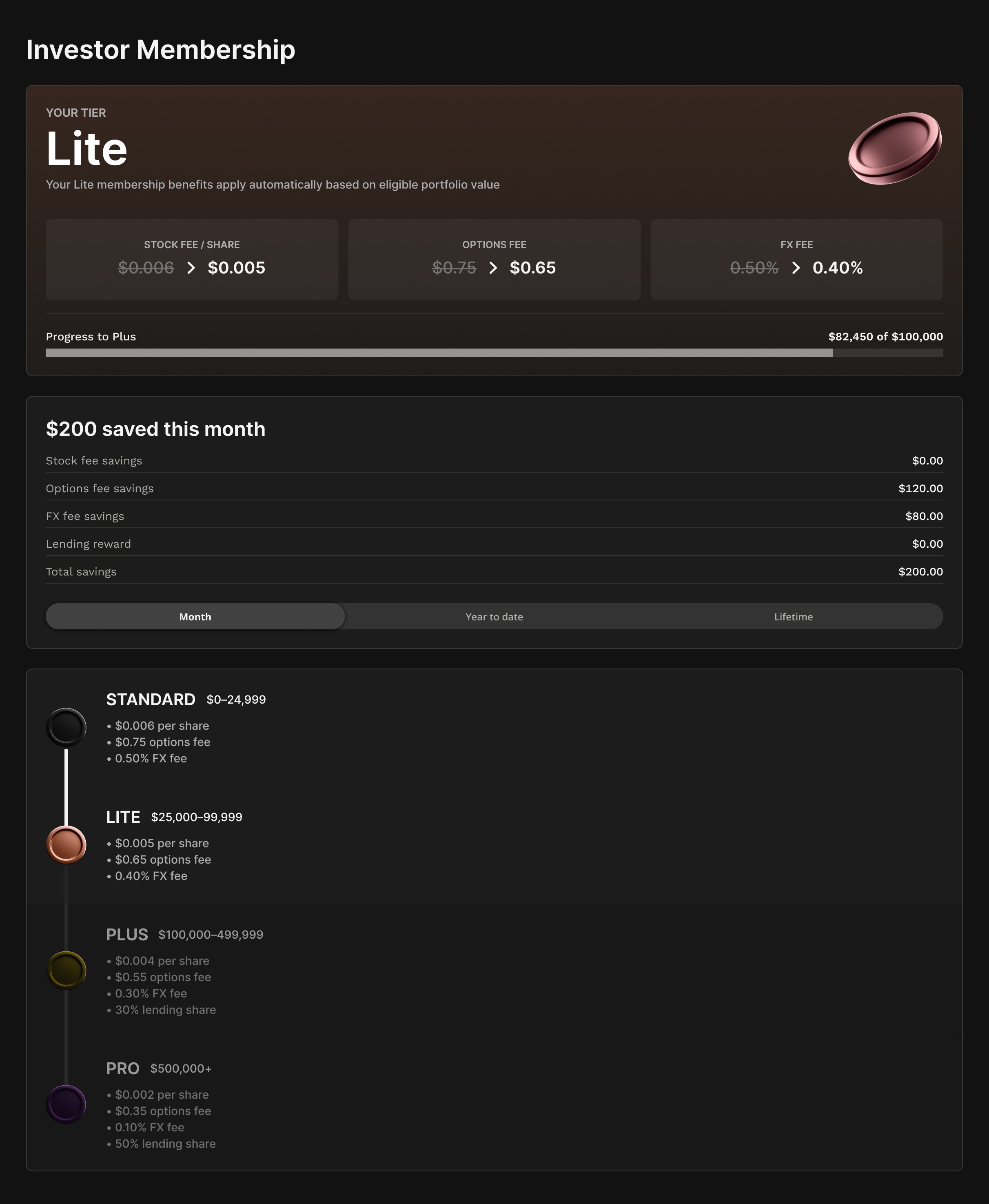
If I already knew the standard rate and the customer’s current rate, why make them find both values and calculate the difference themselves?
If I already knew the standard rate and the customer’s current rate, why make them find both values and calculate the difference themselves?
I put the comparison in the membership header. I kept the full structure below. It was still there when someone needed it, but it no longer dominated the page.
I put the comparison in the membership header. I kept the full structure below. It was still there when someone needed it, but it no longer dominated the page.
Progressive
Simplified

Progressive
Simplified
Progressive
Simplified
Illustrative portfolio reconstruction. Membership names, eligibility thresholds, fees, rewards and savings have been fictionalised and do not represent the original program.
Illustrative portfolio reconstruction. Membership names, eligibility thresholds, fees, rewards and savings have been fictionalised and do not represent the original program.

Put the comparison next to the rate
Put the comparison next to the rate
Previously, customers had to find two values in the table and work out the difference. Putting them next to each other removed that extra step.
Previously, customers had to find two values in the table and work out the difference. Putting them next to each other removed that extra step.

Show value that already happened
Show value that already happened
Instead of estimating future savings, I used past activity to show value the customer had already received. The breakdown showed where the total came from.

Keep the structure, change its job
Keep the structure, change its job
The structure still mattered. Customers needed to know where they were and how qualification worked. I moved it below the current benefits, so it supported the page instead of leading it.
The structure still mattered. Customers needed to know where they were and how qualification worked. I moved it below the current benefits, so it supported the page instead of leading it.
ONE LOOSE END
Anyone remember the vision concept?
Anyone remember the vision concept?
The vision concept still had a job. It introduced the idea before showing all the prices and rules.
The realistic prototype then showed how the membership could actually work.
The vision concept still had a job. It introduced the idea before showing all the prices and rules.
The realistic prototype then showed how the membership could actually work.

Illustrative portfolio reconstruction. Membership names, eligibility thresholds, fees, rewards and savings have been fictionalised and do not represent the original program.
Illustrative portfolio reconstruction. Membership names, eligibility thresholds, fees, rewards and savings have been fictionalised and do not represent the original program.
WHERE I LEFT IT
Ready to test
Ready to test
By the time I left, the study was much less muddled. Interviews checked whether people understood the membership. The survey compared benefits and values. The vision concept tested the idea. The realistic prototype tested how it worked.
By the time I left, the study was much less muddled. Interviews checked whether people understood the membership. The survey compared benefits and values. The vision concept tested the idea. The realistic prototype tested how it worked.
It was ready to test, but three limitations remained.
It was ready to test, but three limitations remained.
Stronger for existing members, weaker for new ones
Stronger for existing members, weaker for new ones
Stronger for existing members, weaker for new ones
Showing past value worked for members with enough account history. It did not work for new customers. They would need a different concept focused on what they could get at the start, rather than savings they had already received.
Showing past value worked for members with enough account history. It did not work for new customers. They would need a different concept focused on what they could get at the start, rather than savings they had already received.
A survey could not predict behaviour
A survey could not predict behaviour
A survey could not predict behaviour
The survey could show which benefits customers preferred and whether stronger offers changed their stated interest. It could not tell us whether a specific rate would change what they actually did. That would require evidence from a live program.
The survey could show which benefits customers preferred and whether stronger offers changed their stated interest. It could not tell us whether a specific rate would change what they actually did. That would require evidence from a live program.
The first concept would still affect the second
The first concept would still affect the second
The first concept would still affect the second
The vision concept and realistic prototype had different jobs, but people would still see one after the other. By the time they reached the realistic prototype, the first concept had already shaped how they thought about the membership. That would affect their reaction to the second one.
The vision concept and realistic prototype had different jobs, but people would still see one after the other. By the time they reached the realistic prototype, the first concept had already shaped how they thought about the membership. That would affect their reaction to the second one.
